The last 12 to 18 months have been volatile. The prediction at the end of 2023 was that the deals market would stabilise at the start of this year and then pick up in the second half. That has proved broadly true and while deals did start slowly, the market is still cautious, and transactions are taking a long time to close.
In a difficult fundraising environment, investors are more selective with their acquisitions, with processes accompanied by enhanced due diligence.
*'Midmarket': deals with an undisclosed value or value between £10-500 million.
How did private equity play out?
Funds’ performance has depended upon their ability to draw and deploy the right level of external debt. Funds which have been able to raise bridge loans and equity for transactions have been more active than funds historically dependent on bank financing.
“There are signs market conditions are settling down now, with a new Government in place providing much-needed stability. Inflation is falling and, although still high, rates have peaked, which means valuations are stabilising. Deals are picking up and overall volume looks set to increase in late Q3 and Q4.”
Humza Khan, Director, Head of Private Equity Coverage
Total UK PE-buyout value and growth capital deal
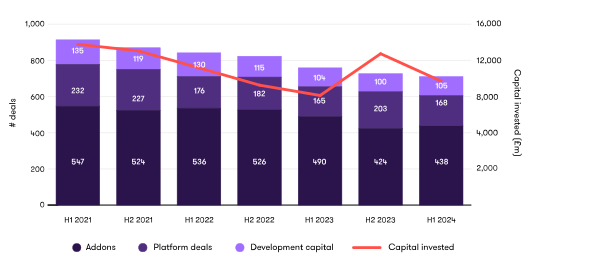
Source: Pitchbook
Total UK PE-buyout volumes (top 10 industry groups) – including addons
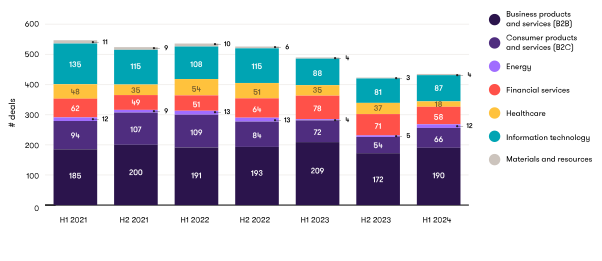
A key talking point across the business landscape in the last few months is how uncertainty around the General Election impacted activity. The actual impact seems to be less than people may have expected, although it's still early days. We knew an election would be called before the end of 2024 and there would be uncertainty around potential tax changes: for example, capital gains tax and carried interest, has subdued the market throughout the year. We’ve seen more addons compared to platform deals, which only picked up in Q2, with funds using M&A to add value to investments. Some deals may have been impacted by the possible reduction to consultancy spend in the public sector, but the actual calling of the General Election in May didn’t suppress activity any further and the confirmation of a majority Labour Government should mean that these deals will return in the short to medium term. Funds are continuing to look internationally, especially for portfolio growth, with addons across Europe, the US, and the Nordics.
In the last few years we’ve also had uncertainty from geopolitical tensions, the cost of living crisis, and supply chain challenges. These pressures have eased and, whereas at the same point last year availability of debt was holding back deals, lender appetite is increasing.
Private equity powering energy transition
Tech-enabled, ESG, and energy transition are fast-moving spaces and there are now dedicated funds focused on these areas of the market. This attention reflects the global move towards decarbonisation. Ed Milliband, the new Secretary of State for Energy Security and Net Zero, recently confirmed the Government’s commitment to making the UK a "clean energy superpower by 2030". We’ve been very active in the related deals space in H1 and earlier. Recent transactions we’ve advised on include Next Energy and the PlanetMark sale to a private equity-backed trade buyer.
Exit strategies
With a subdued London market not presenting the best timing to pursue an IPO exit, there has been a notable increase in secondary buyouts since the first half of 2023. Midmarket deals were up 44% H1 2024 YoY (H1 2024: 56), which can be attributed to several factors. Attractive sectors and growth markets attract seasoned investors looking to deploy unprecedented levels of dry powder. Portfolio businesses that have undergone professionalisation and have strong management teams and margins also present as more viable and stable investment opportunities.
The lenders’ view
“Throughout 2022 and much of 2023, lenders were caught in a perfect storm: high interest rates made borrowing more expensive, while inflation negatively impacted margins and cash generation, putting strain on many borrowers' ability to service debts; directly impacting bank risk appetite and credit decisions.
H1 2024 has seen a significant reduction in the rate of inflation and, consequently, bank base rates, although analyst consensus estimates at the end of 2023 have proven to be optimistic and the BoE cuts are now assumed to be both more limited and coming later. This improved position, together with lenders’ desire to deploy and better data to support credit decisions, has seen a strong return in lender appetite.
Base rates, and therefore debt service, remain a concern and are directly curtailing leverage and debt quantum, but more lenders are active, with improved confidence and competition between lenders resulting in reduced margins being offered and improvements in other terms such as covenant flexibility.
H1 2024 data from Debtwire shows that European institutional loan market volumes, across all sectors and purpose, were more than triple that for the same period last year and 138% up on H2 2023. While most of this deployment was focused on refinancing and maturity extensions, M&A financing has also increased in volume.
While lender appetite is broadly up across the spectrum of borrowers and products, lenders are seeking out new sponsored transactions, especially for key relationship PE houses and new platform investments.”
George Fieldhouse, Partner, Head of CFA Debt Advisory
Report from the American market
“US private equity deal activity increased by 12% in the first half of 2024 as compared to the same period in 2023 based on PitchBook data. This was largely driven by a pick-up in activity during Q2 2023 following a slower M&A market that has persisted since late 2022 driven largely by less attractive financing terms and challenging seller valuation expectations. Many of the deals getting done in the first half of 2024 are add-on transactions and premium assets where banks have started providing slightly more favourable terms. Certain sectors remain more active, notably inflation-indexed industries such as many infrastructure sectors. In addition, private equity firms with strong track records have continued with slower but successful fundraising adding to the growing pool of capital that is ready to be invested. Lastly, the US elections in November, as well as any action the U.S. Federal Reserve may take on interest rates, are likely to bring about new opportunities for investment in the second half of 2024.”
Greg Westfall, National Managing Principal, Private Equity, Grant Thornton US
Sector spotlights
PE always chases growth, and with record levels of dry powder to deploy there are significant opportunities ahead. Consumer markets, the most heavily impacted by the cost of living crisis, are still slow. In contrast we’re seeing lots of potential deals and early activity in energy and energy-transition. The Labour Government is unlikely to move us back towards fossil fuels. Traditionally strong sectors, such as healthcare, are robust, with medical devices drawing particular interest, and the TMT market continues to perform strongly, particularly from US investors.H1 2024 sector performance
The B2B products and services sector is the most active in terms of deals done and is growing as a proportion of all deals. Over 2021 and 2022 it averaged 36% of all deals. Since 2022 this share has increased to 41%. On the equivalent period in 2023, volumes were down 9% but grew 2% on H2 2023.
Technology volumes have been recovering since the end of H1 2023, where the market bottomed out at 40% below their recent peak. On the equivalent period in 2023, it has had the strongest growth at 16%. On H2 2023 it grew at 6%. Platform deals have recovered from their H1 2021 low to grow by 87% in H1 2024 YoY, a trend seen also in financial services and healthcare, which grew 60% and 56% respectively. Technology companies also received the most development capital, up 35% on H1 2023.
Apart from a small increase in 2023 H1, B2C volumes have been falling since H2 2021 when B2C deals represented a fifth of all deals done. This has now dropped to around 15%. Financial services deals, which had grown steadily from H1 2021 to H1 2023, have now started falling again. A similar downward trend can be seen in the add-on market, where only healthcare grew, albeit from a relatively small base.
B2B products and services
Total volume
- Total: 296 (-8.9%)
- Platform deals: 72 (-13.3%)
- Addons: 190 (-9.1%)
- Development capital: 36 (+9.1%)
Highest-value deals
|
Deal size |
Company |
Investor |
Subsector |
|
£483 million |
Impellam |
Icelake Capital / Kartesia |
Staffing / outsourcing |
|
£464 million |
Urbaser’s UK business |
CPP Investments |
Waste services |
|
£307 million |
DX Group |
H.I.G Europe |
Freight and logistics |
B2C products and services
Total volume
- Total: 109 (-14.8%)
- Platform deals: 25 (-26.5%)
- Addons: 66 (-8.3%)
- Development capital: 18 (-18.2%)
Highest value deals
|
Deal size |
Company |
Investor |
Subsector |
|
£284 million |
Tenpin |
Trive Capital |
Leisure |
|
£105 million (Development Capital) |
Ipswich Town FC |
Bright Path Sports Partners, Clara Vista Investment Partners |
Sport |
|
£95 million (development capital) |
Anton |
BlackRock and Clara Vista Investment Partners |
TV production |
Financial services
Total volume
- Total: 82 (-16.3%)
- Platform deals: 16 (+60%)
- Addons: 58 (-25.6%)
- Development capital: 8 (+20.0%)
Highest-value deals
|
Deal size |
Company |
Investor |
Subsector |
|
£432 million |
Mattioli Woods |
Pollen Street Capital |
Wealth management and employee benefits |
|
£240 million |
Penney, Ruddy & Winter |
Beech Tree Private Equity |
Financial planning |
Healthcare
Total volume
- Total: 39 (-17.0%)
- Platform deals:14 (+55.6%)
- Addons: 18 (-48.6%)
- Development capital: 7 (+133.3%)
- Entries 21 (+34.8%)
Highest-value deals
|
Deal size |
Company |
Investor |
Subsector |
|
£207 million |
Berkley Care |
Clariane |
Elderly care |
|
£70 million |
Renaissance Pharma |
Gyrus Capital, Headway Capital Partners, Yana Investment Partners and Connection Capital |
Pharma |
Tech
Total volume
- Total: 146 (+15.9%)
- Platform deals: 28 (+86.7%)
- Addons: 87 (-1.1%)
- Development capital: 31 (+34.8%)
Highest-value deals
|
Deal size |
Company |
Investor |
Subsector |
|
£471 million |
Focus Group |
HgCapital |
IT services |
|
£368 million |
GRC Group |
Inflexion |
Software |
|
£316 million |
IQGeo |
KKR |
Software |

Podcast: H1 Private equity market review
You can find more insight on how private equity performed in H1 2024 in our podcast. Listen to episode 15 of ‘behind the transaction'.
The outlook
“Even though we haven’t seen the rush of deals predicted at the start of Q1, the current uptick bodes well for the next six months. The public markets are predicted to open up this year. They’re a reliable bellwether for the private markets. Now that we’ve passed through the General Election, we’re going to have more deals, although the effect will probably be delayed. Some deals that would have closed in Q3 were paused by the political uncertainty, and we're likely to see them close in Q4. Some funds have also been holding on to assets longer than they intended and want to be ready to go to market after the summer. They need to do a deal, so we’re likely to see more secondaries.
These developments all point to a return to ‘normal’ circumstances: Brexit, COVID-19; ‘Trussonomics’; the cost of living crisis, have all felt like temporary disruptions, but perhaps we should be thinking of this type of event as ‘normal’. Adaptability and finding opportunities for confidence in difficult circumstances should be business as usual. There are positive signs that conditions are getting easier, the markets are upbeat, inflation is declining and there are signs that interest rates will be cut. Political stability looks set for the next few years and Labour have repeatedly committed to prioritising growth.“
Pete Terry, Partner, Head of Private Equity




Get the latest insights, events and guidance
Straight into your inbox